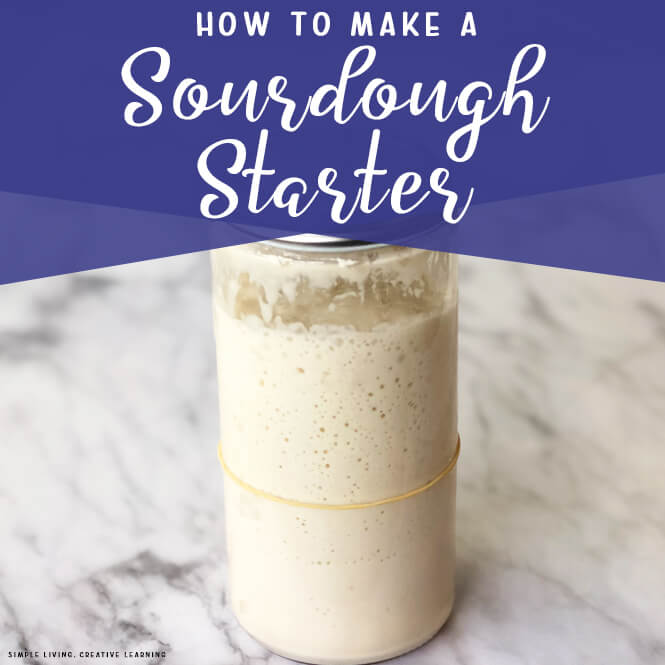
How to Make Sourdough Starter
Making a sourdough starter is not as hard as you may think. Yes, it does take some time, but with this simplified version, even beginners will be making their own sourdough goodies soon enough.
Print
Save
Pin
Facebook
Email
Add to Collection
Equipment
- Glass jar with lid
- Kitchen Scales
- Spatula
Ingredients
Day 0
- 125 g Unbleached Plain Flour
- 125 g Water
Day 2
- 125 g Unbleached Plain Flour
- 125 g Filtered Water
Day 3
- 125 g Unbleached Plain Flour
- 125 g Filtered Water
Day 4
- 125 g Unbleached Plain Flour
- 125 g Filtered Water
Day 5
- 125 g Unbleached Plain Flour
- 125 g Filtered Water
Instructions
Day 0
- To make your sourdough starter, I use a large 1000ml glass jar with straight sides and its lid. This way it is easier to keep an eye on the starter to make sure that it is doing all that it needs to do and is being fed when needed.You will also need:First, clean and dry the glass jar that you will be storing your sourdough starter in. Weigh the empty jar and write this weight down on your paper along with the date and time that you are starting your starter.Mix the flour and water in the bowl, then transfer to your glass jar. Add the lid and place the rubber band around the outside of the jar at the level where the sourdough starter is.Set aside in a warm draught-free place for 48 hours.After 12 hours, there will not be much change in your mixture, except for possibly a few bubbles that may be starting to form. By the end of the 48 hours, the starter may have risen slightly. There may also be a dark skin and more bubbles on the surface, and even a few that can be seen through the side of the jar. If you see these signs proceed to the first feeding.If you don't see these signs, set aside for another 24 hours. If it is still showing none of these signs after this, proceed to first feeding.
Day 2 - First Feeding after 48 Hours
- Remove and discard all but 125g of the sourdough starter from the jar. (Add 125g to the weight of the empty jar and use this)Mix 125g unbleached plain flour and 125g bottled or filtered water together in the bowl. Transfer to the jar and mix into the 125g of sourdough starter. Or, just mix it up in the jar.Use the clean spatula to scrape down the sides of the jar. I recommend to do this after every feed as it will make it easier to see how much the dough is rising.Seal the jar and set aside into a warm, draught-free place for 24 hours.After this feed and rise, the starter should have risen slightly and contain random bubbles on the surface as well as ones that can be seen through the sides of the jar. This is what you want to see as it indicates that the wild yeast is active and starting to multiply.
Day 3 - Second Feeding after 24 Hours
- Remove and discard all but 125g of the sourdough starter from the jar. (Add 125g to the weight of the empty jar and use this)Mix 125g unbleached plain flour and 125g bottled or filtered water together in the bowl. Transfer to the jar and mix into the 125g of sourdough starter. Or, you can mix it in the jar.Use the clean spatula to scrape down the sides of the jar. I recommend to do this after every feed as it will make it easier to see how much the dough is rising.Seal the jar and set aside into a warm, draught-free place for 24 hours.After this feed and rise there will be more bubbles visible, though they will be smaller and more uniform. The aroma will be less pungent, and a little sweeter.
Day 4 - Third Feeding after 24 Hours
- Remove and discard all but 125g of the sourdough starter from the jar. (Add 125g to the weight of the empty jar and use this)Mix 125g unbleached plain flour and 125g bottled or filtered water together in the bowl. Transfer to the jar and mix into the 125g of sourdough starter. Or, mix it in the jar.Use the clean spatula to scrape down the sides of the jar. I recommend to do this after every feed as it will make it easier to see how much the dough is rising.Seal the jar and set aside into a warm, draught-free place until doubled in size. This will take anywhere from 8 to 24 hours.After this feed and rise, the starter may rise up to 100% in less than the 24 hours. Bubbles will be evident on the surface as well as through the sides of the jar. The aroma will be tangy, though sweet.
Day 5
- If your starter has not doubled in the 24 hours (or less) than continue with the discarding and feeding process - discard, then mix 125g sourdough starter, 125g unbleached plain flour and 125g filtered or bottled water - every 12 hours until your starter is strong, doubling in size in 8 hours or less.When it does double in size, then it is 'active' and ready to use or store in the fridge to be used at a later date.If your starter dough doubles in size in less than 24 hours, you may notice that is starts to lose volume, falling back on itself. This indicates that it needs a feed. To make sure your starter is strong enough to use in baking, you will need to feed it regularly.
Tried this recipe?Check out Share a pic on Instagram!
Nutritional information is an estimate and provided as a courtesy. The values may vary according to the ingredients and tools that are used. Please use your preferred nutritional calculator for more detailed information.