
Homemade Healing Plantain Salve
This easy to make homemade healing plantain salve is a herbal remedy that will help soothe bug bites, itching, rashes and more.
Print
Save
Pin
Facebook
Email
Add to Collection
Servings: 6 oz
Equipment
- 3-4 2 Oz Tins
Ingredients
- Dried Plantain Leaves
- 1 Cup Avocado Oil
- 2 TBSP Beeswax Pellets
Instructions
- Before making plantain salve, you will need to make a herb infused oil. After the infusion period has ended, this oil is then mixed with beeswax to make a salve.To do this, fill a glass jar half full with dried plantain leaves.

- Pour over the avocado oil until the jar is completely full, making sure that all the leaves are fully covered.

- Add the lid to the jar and keep in a cool, dark area.
- Infuse for 4 – 6 weeks, shaking every now and then when you walk past. Shaking is not absolutely necessary, so if you forgot, don’t stress about it. Infusing oils can also be done in a crockpot on the warm setting or on the stove.
- Once you have the infused oil, strain out the herbs using a cheesecloth and pour the oil into a clean, glass jar. The herbs that are leftover can be added to your compost bin.
- This recipe will make 3-4 x 2 oz tins of salve.
- Add the beeswax to your infused oil. Heat on medium low in a double boiler.
- This process can also be done in the microwave. Just add the beeswax and the infused oil to a microwaveable jug and heat in 30 second intervals, stirring in between each interval, until fully melted.
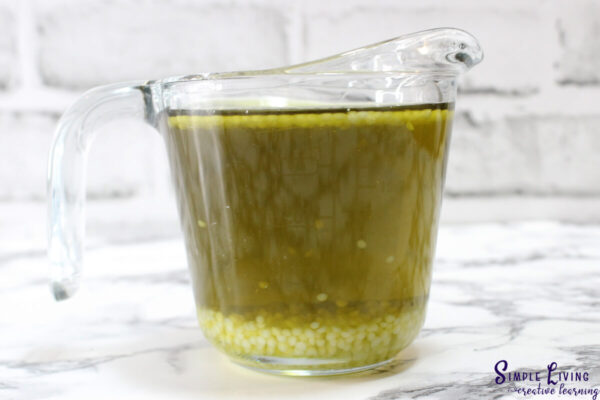
- Once melted, you can add a small amount of vitamin E oil, if you wish.
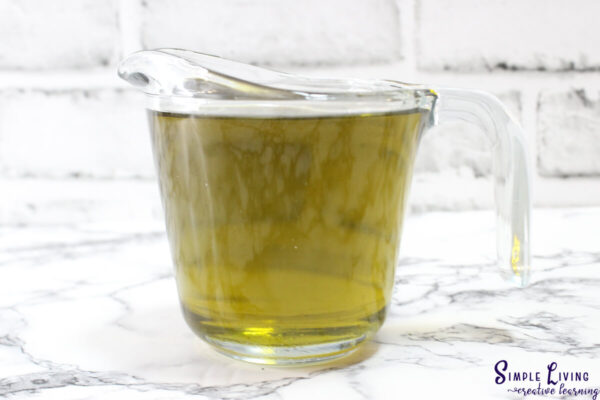
- Pour the mixture into your tins.

- Leave, uncovered, for a few hours or overnight, to set.

- To Use: Simply spread the salve onto clean wounds, stings, or rashes as needed. You can cover lightly with a cloth to prevent the oil from staining clothes, if you wish.

Tried this recipe?Check out Share a pic on Instagram!
Notes
- This recipe yields approximately 3-4 x 2oz tins.
- The salve can be stored in a cool, dry place for up to six months.
- You can add essential oils to make it become a stronger pain salve.
- You can also add in vitamin e oil to help preserve the salve as well.
- I live in a hot climate, so this is made with extra beeswax to stop it from melting during hot summers, thus making this a harder salve. You may want to decrease the beeswax if you live in a cooler climate. You can test the consistency of your salve by placing a small amount of mixture into the freezer for 2 minutes. Then take it out and let it come to room temperature before testing its hardness. If it is too soft, add a little more beeswax, if too hard, add a little more oil.
- You can substitute carnauba wax for beeswax, though it is harder than beeswax, so you will probably need to decrease the amount slightly. Cocoa butter could also be used, though again, you will need to test the quantities.
- Vitamin E is optional, and is often added to salves as an antioxidant to prevent rancidity, as well as for its amazing skin-healing properties.