
Homemade Fermented Carrots
Making fermented carrots is one of the easiest fermented vegetables to start with & taste great in salads, with sandwiches and more.
Print
Save
Pin
Facebook
Email
Add to Collection
Servings: 1 Quart Jar
Calories: 38kcal
Equipment
- For Brine - 1 pint jar, lid and ring
- 1 Quart Glass Jar, wide mouth
- 1 Wide Mouth Quart Jar Ring
- 6x6 in piece of fabric
- Glass Pebble
- Water - spring
- Label
Ingredients
- 2 lbs (1 kg) whole carrots
- 1 lime
- 1-2 tsp chilli pepper flakes, optional
- 1 thumb size piece of fresh ginger
- 4 tsp fine sea salt
Instructions
- Make brine first by adding 4 tsp of fine sea salt into pint jar of cool water (not warm, not cold). Cover and shake vigorously, set aside and shake a few more times during this process to help the salt dissolve.

- Cover and shake vigorously, set aside and shake a few more times during this process to help the salt dissolve.
- Carrots can be scrubbed or peeled. Cut carrots into lengths that stay an inch below the ring of the quart jar. Carrots will ferment best if they are cut into 8ths lengthwise. This allows them to be thin enough to ferment, yet sturdy enough to hold and eat.

- Peel and chop fresh ginger. Too small of pieces will float to the top of the brine, which contributes to mould, so a rough chop or dice is good.
- Cut into the lime peel and pull away large pieces. Slice the peel into long thin strips. Add in ¾ or all of the lime peel strips.
- Place the chili flakes, ginger, and lime peel in the bottom of the quart jar.

- Stack the carrots lengthwise, tightly!

- Shake brine again and pour onto carrots.

- Add glass pebble, cover with fabric, and screw on lid. If you don't have a glass pebble, a ziploc bag filledwith water can be used, or a small jelly jar or other jar. These are used as weights to keep the carrots below the brine line.

- Add a label with the date and ingredients. Set on counter or in cool space with temps between 60-70˚F (15-21˚C) for 1-2 weeks.
- Start checking on carrots day 3.
- If Kahm yeast develops, which may have a pink hue if pink Himalayan salt is used, use a clean paper towel to completely wipe it out.
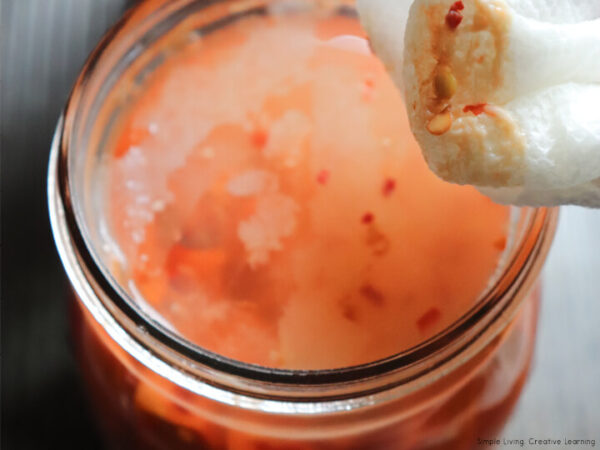
- Start taste testing day 5 and then again every couple days.
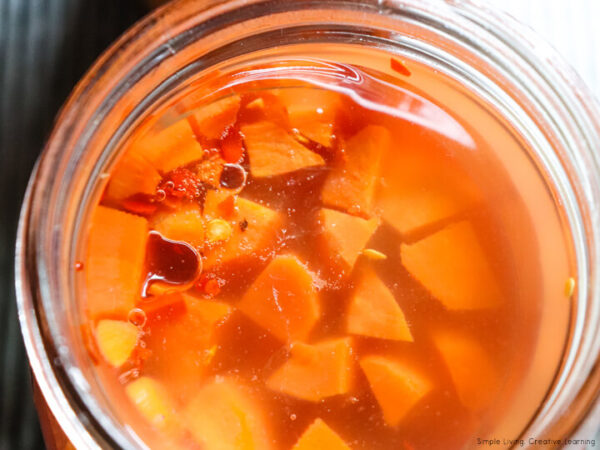
- When the flavor is just right, seal jar with jar ring and lid and keep in the refrigerator. Ferments can keep in the fridge for several months.

Tried this recipe?Check out Share a pic on Instagram!
Notes
- Salt: Fine Sea Salt or Himalayan Sea Salt are preferred for fermenting. Iodized salt will stop the fermenting process as will any caking type salts.
- Kahm Yeast: is not mould. This yeast is safe to eat, though many prefer to wipe it out with a clean paper towel, as it can alter the taste of the fermented food. Removing it is very easy to do. Just skim the surface with the paper towel until all of the Kahm Yeast is removed. Any white clusters, floating near the surface may be mould. If it has not started to color and has not touched the food, you can remove it and still eat the ferments.
- Storing Ferments: Keep the ferments in a cool place between 60-70˚ F or 15-21˚C. It does not have to be a dark place. The counter top is fine. I would avoid storing ferments in the basement as they tend to be damp and may have mould spores present.
- Coverings: Instead of using a piece of cloth, place the silicone top on to the jar and screw on the mason jar lid.
Nutrition
Calories: 38kcal | Carbohydrates: 11g | Protein: 1g | Fat: 0.4g | Saturated Fat: 0.1g | Polyunsaturated Fat: 0.2g | Monounsaturated Fat: 0.03g | Sodium: 9309mg | Potassium: 173mg | Fiber: 3g | Sugar: 3g | Vitamin A: 1673IU | Vitamin C: 21mg | Calcium: 31mg | Iron: 1mg
Nutritional information is an estimate and provided as a courtesy. The values may vary according to the ingredients and tools that are used. Please use your preferred nutritional calculator for more detailed information.